
Glossary
Garden pond glossary
Plain-English definitions of UK garden pond terms, from aeration and blanketweed to turnover and UV clarifiers.
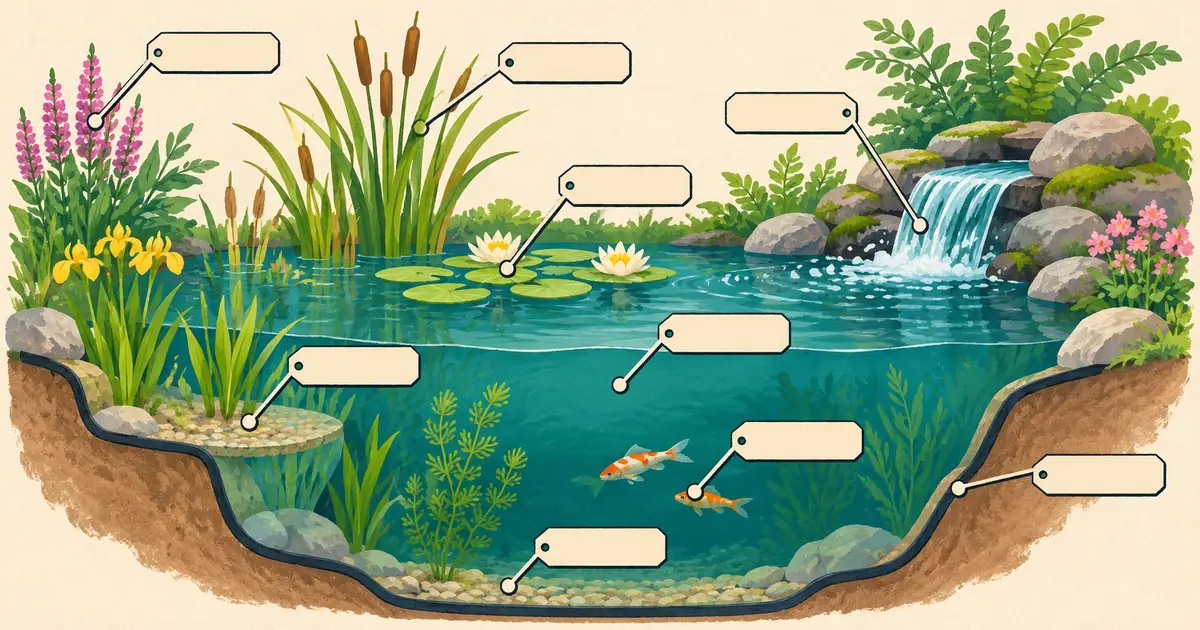
Use this A–Z glossary when a pond guide, product label or installer uses an unfamiliar term. Each definition points to a relevant Pond Setup Guide page where one exists.
Aeration
Adding air to water, usually by moving the surface with a fountain, cascade or air pump. The RHS describes a fountain or cascade as a way to aerate a pond. See pond waterfalls and streams.
Algae
Simple plant-like organisms that photosynthesise but do not have true roots, stems or leaves. Suspended single-celled algae can turn water green; thread-like algae form strands. See green pond water.
Aquatic basket
A perforated planting container used for pond plants. The RHS recommends aquatic baskets with loam-based or aquatic compost for most pond plants. See plants for a wildlife pond.
Blanketweed
Long, hair-like green strands of algae that float in or on the water or cling to plants. It is different from the tiny suspended algae that make water look like pea soup. See the blanketweed guide.
Dechlorinator
A water-treatment product intended to deal with disinfectants in mains water. Follow its label; it does not remove the nutrients that can encourage algae. Rainwater is usually the better top-up for a wildlife pond. See topping up a pond.
Duckweed
Tiny free-floating plants in the genus Lemna. A little can be part of a pond, but a dense mat blocks light from submerged plants. See how to deal with green pond water.
EPDM
A synthetic rubber used for some flexible pond liners. It is one liner material rather than a size or thickness. See preformed pond or liner.
Filter, biological
The part of a filter where microorganisms process fish waste. A new biological filter needs time to establish, so a maker's instructions matter when starting a fish pond. See pond filter sizing.
Filter, mechanical
The part of a filter that physically traps suspended debris. It needs cleaning in the way and at the interval specified by the filter maker. See pond filter sizing.
Flow rate
The volume of water a pump moves in a given time, commonly stated in litres per hour. Real flow at the pond can be lower than the headline figure once the pump lifts water. See pond pump sizing.
Head
The vertical lift and resistance a pump must work against. Pump makers publish curves showing how flow falls as head increases. See pond waterfalls and streams.
Invasive aquatic plant
An aquatic plant that spreads aggressively and can harm habitats. Some listed species are subject to legal controls, and GOV.UK warns that even small fragments can spread during pond maintenance.
Liner underlay
A protective layer placed between the ground and a flexible pond liner to reduce the chance of puncture from stones or roots. See fitting a pond liner.
Marginal plant
A plant grown at the shallow edge of a pond or in a boggy margin. Marginals soften the edge and provide cover and stems for wildlife. See plants for a wildlife pond.
Native plant
In RHS usage, a plant that originated or arrived naturally in a place without human involvement. Native plants can be valuable, but being native does not automatically make a plant suitable for every small pond.
New pond syndrome
A plain-language name for water-quality trouble when fish waste builds up before a new biological filter has established. Avoid rushing fish into a new system. See the first weeks of a new pond.
Nitrate
A plant nutrient. Freshwater Habitats Trust identifies nitrate and phosphate as nutrients associated with excessive algae and duckweed in ponds.
Oxygenator
A submerged pond plant that produces oxygen during daylight and provides underwater cover. The RHS lists hornwort and water starwort as examples. See plants for a wildlife pond.
Pond volume
The amount of water a pond holds, normally stated in litres. For a rectangular pond, volume is based on average length, width and depth. Use the pond planner or read how big a pond should be.
Preformed pond
A rigid moulded pond shell with a fixed shape and depth. It is quicker to place but less flexible than sheet liner. See preformed pond or liner.
Pump curve
A maker's chart showing the flow a pump can deliver at different head heights. Choose from the curve at the pond's working head, not from the zero-head number on the box. See pond pump sizing.
Rainwater
Water collected from rainfall. Official wildlife-pond guidance prefers it to mains water because tap water can add nutrients that encourage algae. See topping up a pond.
RCD
A residual current device, which cuts the supply when it detects a fault. Electrical Safety First says a mains garden pump should be RCD-protected and installed to the maker's instructions. See pond pump electrics.
Shelf
A level step formed around part of a pond edge to support baskets of marginal plants. Shelves also create different water depths, but a wildlife pond still needs a gentle exit. See digging a garden pond.
Silt
Fine sediment and decaying organic matter that settles on the pond bottom. It is habitat as well as debris, so wildlife guidance recommends considering the pond community before removing it. See spring pond cleaning.
Skimmer
A device that draws floating debris from the water surface into a basket or filter. It is equipment for managing debris, not a substitute for preventing heavy leaf fall.
Turnover
The relationship between pump flow and pond volume, often expressed as how frequently the pond's water could pass through the system. It is a sizing guide, not a promise that every drop follows the same route. See pond pump sizing.
UV clarifier
An ultraviolet unit fitted in a circulating system to help a filter remove suspended green-water algae. It does not remove blanketweed. See UV clarifier sizing.
Wildlife ramp
A stable rough-surfaced route from the water to the bank for animals that cannot climb a smooth, steep side. A broad beach edge is better when the pond design allows it. See escape routes for pond wildlife.
Zooplankton
Tiny animals drifting in the water. Freshwater Habitats Trust notes that fish eat the zooplankton that would otherwise graze algae, one reason fish can change a wildlife pond.
Sources
- RHS: choosing pond plants — accessed 14 November 2026.
- RHS: pond algae and blanket weed — accessed 14 November 2026.
- Freshwater Habitats Trust: frequently asked questions — accessed 14 November 2026.
- GOV.UK: invasive non-native plant rules — accessed 14 November 2026.
- Electrical Safety First: garden electrical safety — accessed 14 November 2026.